



- Photovoltaic
- Labelling
- FlexibleCircuitry
- Transfer & Release
- Electrical Insulation
- Flexo & Offset
- Biomedical
- Differentiated Industrial Applications


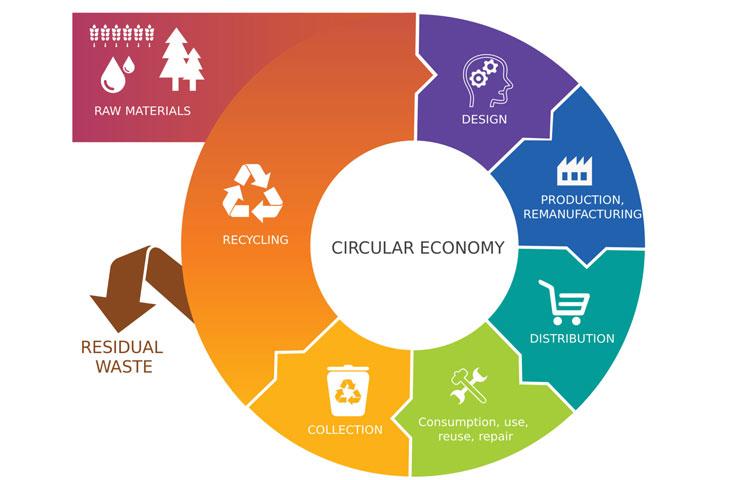
Coveme's commitment to a sustainable future is reflected in the numerous environmental and social activities carried out by the company. Within the production activity, particular attention is paid to central themes such as: the implementation of production processes designed to limit emissions and consumption, the development of eco-sustainable, recycled and recyclable products, and the feasibility study of a closed loop recycling project (i.e. circular economy) that the company is carrying out together with scientific and industrial partners.
Educational programs, sports sponsorships and donations to charities both nationally and internationally complete the picture of a long-lasting and constant social commitment by Coveme.
The company is certified ISO 14001: 2015 for environmental management, an important certification that testifies to the awareness of wanting and being able to contribute to a model of sustainable growth, which places the environmental issue at the centre. Coveme also obtained the Ecovadis rating, a platform that evaluates the sustainability performance of companies, receiving the silver medal and the Ecomate rating, which certifies the solidity of the company from the point of view of environmental, social and governance aspects.
In 2023 Coveme finally completed its first sustainability report and calculated the company's Carbon Footprint (CFP) according to the GHG Protocol, scopes 1,2,3.
 Download Sustainability report
Coveme is ISO 14001: 2015 certified for environmental management since 2012 and ISO 45001 certified for occupational health and safety, wheras in 2021 it received the Bronze Medal of the Ecovadis rating and the Ecomate rating, platforms that evaluate the solidity of society from an environmental, social and governance point of view.
The company also published its first Sustainability Report in 2023 and calculated the organizational Carbon Footprint according to the GHG Protocol, purposes 1,2,3. The next step will be to implement a Strategic Decarbonisation Plan for the group.

In 2012 the company adopted the international standard ISO 14001 which establishes the requirements for an environmental management system. For Coveme, the voluntary adoption of an environmental management system means committing itself to reducing its impacts, paying attention to the consumption of natural resources and improving its environmental performance in compliance with legal requirements.
This is a strategic choice for Coveme, which is aware of the value and importance of being able to contribute to a sustainable growth model that places the environmental issue at the center.
Coveme, by pursuing the environmental management policy of ISO 14001, participates in the achievement of some of the objectives in the UN Agenda 2030 for sustainable development, more precisely Goals 7,8,9,12,13.
The continuous attention in guaranteeing adequate working conditions in terms of health and well-being has led Coveme to obtain the ISO 45001 certification. This standard with its systemic approach guides the company in risk management, in managing legislative compliance, the diffusion of increasingly safe work practices, and in the assessment of workers' health.
Coveme, by promoting the occupational health and safety policy of ISO 45001, participates in the achievement of some of the objectives in the UN Agenda 2030 for sustainable development that are Goals 3 and 8.
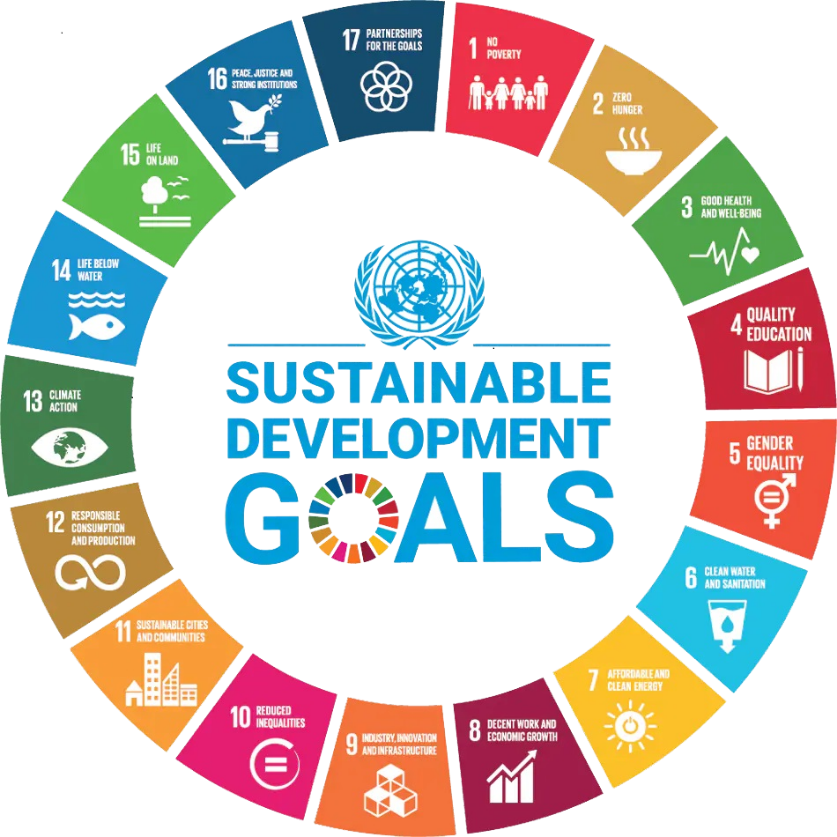
The UN Agenda 2030 is an action program for people, the planet and prosperity signed in September 2015 by the governments of the 193 UN member countries and incorporates 17 different objectives for Sustainable Development, the Sustainable Development Goals, short SDGs.
The official launch of the Sustainable Development Goals was at the beginning of 2016, and these goals have the task of guiding the world over the next 15 years with the aim to help the countries involved in their achievement by 2030
In 2024 Coveme received the bronze medal from the Ecovadis rating, a platform that evaluates the sustainability performance of companies which places the company in the highest 82nd percentile of the market. Coveme's overall score was 63/100, which is 35% higher than the industry average. This is a great achievement for the Coveme team.
The rating is based on the main international sustainability standards that take into account the sector, size and geographical location of the company.
The score takes into account the policies adopted, the actions taken and the results obtained by Coveme with respect to 21 sustainability criteria collected in four macro-areas: environment, work practices and human rights, ethics and sustainable purchases.
To download the certificate click here
Coveme obtained an ESG rating through the Ecomate platform. Ecomate certifies the solidity of the company from an environmental, social and governance point of view. In 2022 Coveme obtained the BBB level, a result that incorporates the company's assessment on eleven modules spread across ESG issues.
The results obtained in recent years and the desire to do better and better testify to Coveme's constant commitment to the issues of corporate social responsibility (CSR) and led the company, firstly to the drafting of the group's first Sustainability Report and, subsequently, to the calculation of the Organizational Carbon Footprint of the entire Coveme group, according to the GHG Protocol (scopes 1,2,3).
In the near future, based on the data collected from the analysis carried out, the company will implement a medium and long-term Decarbonization Strategic Plan in which the various actions to be implemented in the coming years and in the different company areas will be identified.
As a manufacturing reality, our major investments are aimed at production capacity and the efficiency of the production process. Concentrating investments on innovative production technologies with low environmental impact, as well as on the well-being and professional development of our employees, it means carrying forward a business model that is not only profitable but also sustainable in future years.
Coveme is working in partnership with customers and suppliers to offer the market eco-friendly products and to contribute to a circular economy and "Life Cycle Assessment (LCA)" process:
Coveme promoted the study of the Carbon Footprint through the LCA (life cycle assessment) analysis of two products representative of the range offered to the market. A backsheet film for solar panels and a Kemafoil® film for various industrial uses.
These analyzes were carried out by the Politecnico di Milano and by Gesteco, a company that develops integrated solutions for the environment.
Click here to see the LCA study of solar module backsheet film
Click here to see the LCA study of Kemafoil® film for different industrial uses.
To learn more about specific Green and recycled products, click:
Transfer release sustainable products
Photovoltaic sustainable product


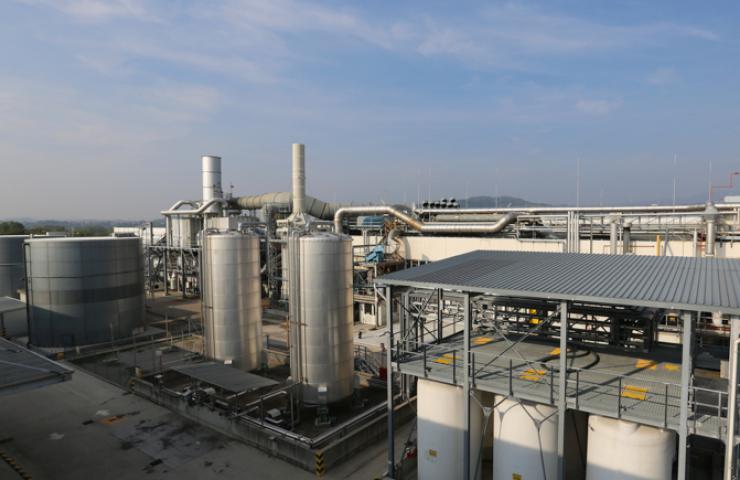




In 2023, Coveme decided to draw up its first sustainability report driven by the awareness that today sustainability has become a central element for the success of a company.
The sustainability report is important because it offers a complete picture of a company's activities and performance, paying attention to the balance of economic, social and environmental aspects in order to create long-term value for the company and for future generations.
Coveme was accompanied on this journey by Hidra, a benefit company, specialized in consultancy for sustainable strategic innovation.
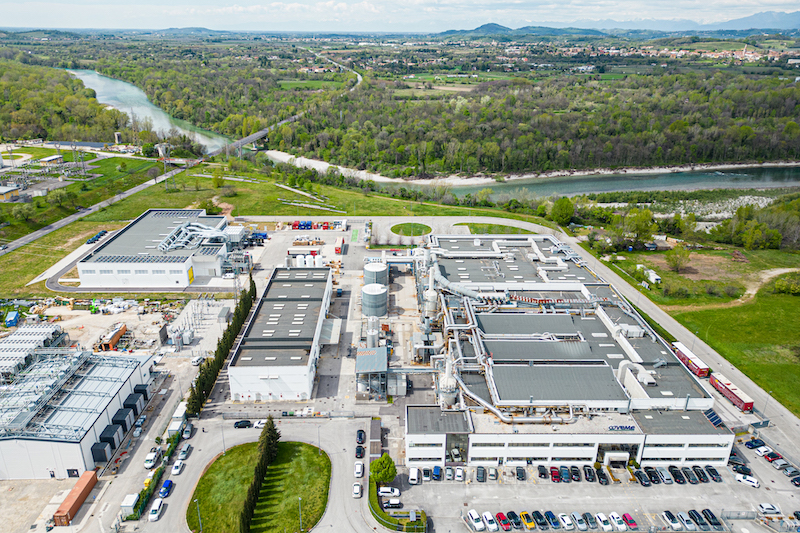
This can also translate into competitive advantages and new growth opportunities for the company.
We hope that you too will join us in this journey!
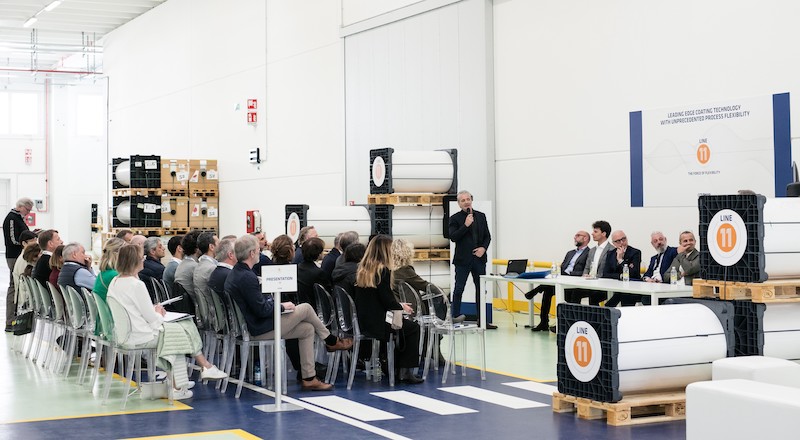
Nel contesto della sostenibilità aziendale, il calcolo del Carboon Footprint (CFP) aziendale è legato alla misurazione delle emissioni di gas serra generate dall’organizzazione attraverso degli standard internazionali condivisi (GHG Protocol).
Il GHG Protocol, nato nel 1997, è stato sviluppato per fornire uno standard internazionale per la contabilità e rendicontazione delle emissioni di gas serra (CO2) da parte di aziende e organizzazioni e fornisce una guida metodologica su come misurare le emissioni in 3 scopi o ambiti diversi:
• Scope 1: comprende tutte le emissioni dirette dell’azienda
• Scope 2: comprende le emissioni indirette associate all’acquisto di energia elettrica
• Scope 3: comprende tutte le emissioni indirette che si verificano lungo la catena del valore dell’azienda, sia a monte che a valle dell’organizzazione.
Nel 2023 Coveme group ha svolto il calcolo della propria impronta di carbonio organizzativa al fine di poter implementare successivamente un piano strategico di decarbonizzazione della società.
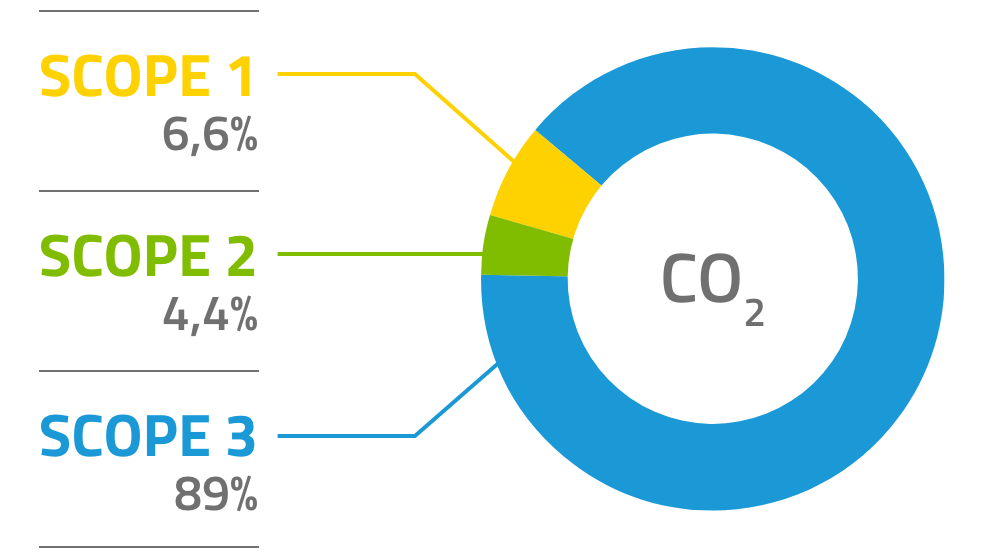
Dalla misurazione delle emissioni (CO2) del gruppo Coveme, secondo il GHG Protocol, è emerso che nel 2023 le emissioni derivanti dagli scopi 1 e 2 rappresentano l’11%, mentre quelle derivanti dallo scopo 3 rappresentano
l’89% del totale.
Il CFP (Carbon Footprint of a Product) è la somma delle emissioni e delle rimozioni di gas serra in un sistema di prodotto, espressa come equivalenti di CO2 e basata su una valutazione del ciclo di vita utilizzando la singola categoria di impatto del cambiamento climatico.
A livello del gruppo Coveme, sono stati seguiti gli orientamenti del protocollo sui gas a effetto serra (GHG), che consistono nella quantificazione e categorizzazione delle emissioni indirette e dirette.
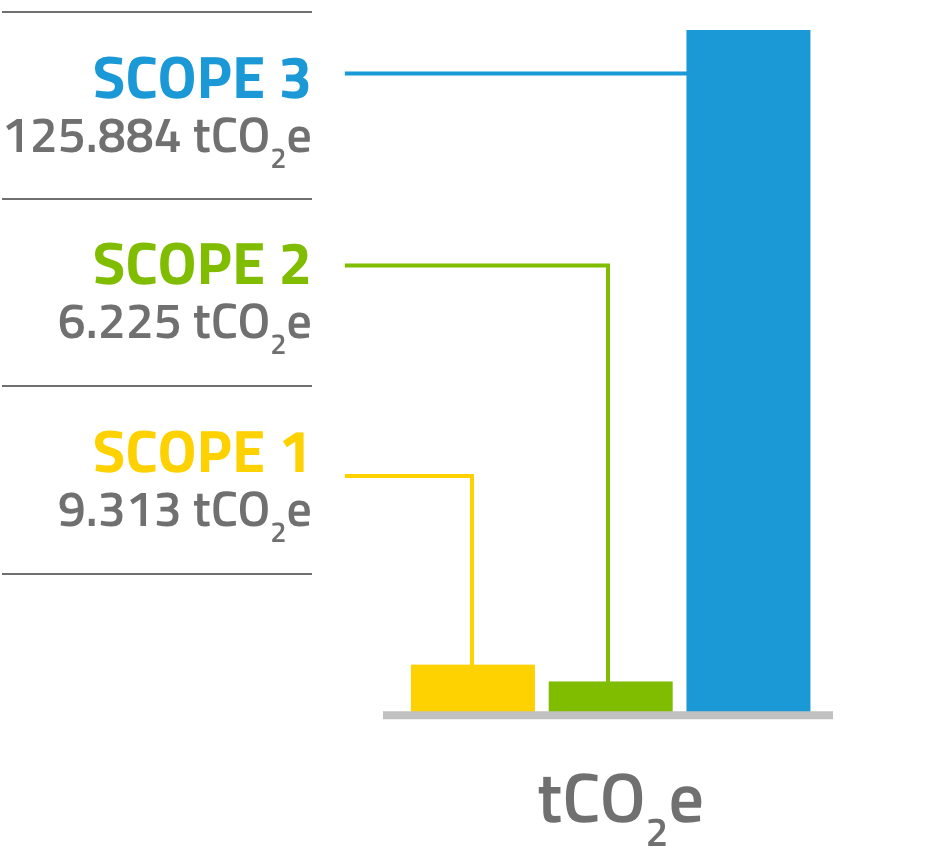
Nel corso del 2023 abbiamo quantificato le emissioni annue di gas serra a livello del gruppo Coveme organizzazione, erano 141.422 tonnellate di CO2 equivalente.
• Le emissioni e gli assorbimenti diretti di gas serra inclusi nello Scope 1, secondo la norma ISO 14064-1, sono di 9.313 tCO2e.
• Le emissioni indirette di energia importata, corrispondenti allo Scope 2, sono pari a 6.225 tCO2e.
•. Le emissioni indirette dello Scope 3 comprendono tutte le emissioni indirette che si verificano lungo la catena del valore dell’azienda, sia a monte che a valle dell’organizzazione e sono pari a 125.884 tCO2e.
Nel corso dell’analisi svolta sono state mappate e misurate tutte le fonti dirette ed indirette delle emissioni generate dall’azienda e grazie a questa classificazione Coveme può ora decidere quali azioni intraprendere per cercare di ridurre le proprie emissioni.
Come prossimo passo Coveme redigerà un Piano Strategico di Decarbonizzazione di medio e lungo termine in cui saranno identificate le diverse azioni da implementare nei prossimi anni nei diversi ambiti aziendali.
Coveme is ISO 14001: 2015 certified for environmental management since 2012 and ISO 45001 certified for occupational health and safety, wheras in 2021 it received the Bronze Medal of the Ecovadis rating and the Ecomate rating, platforms that evaluate the solidity of society from an environmental, social and governance point of view.
The company also published its first Sustainability Report in 2023 and calculated the organizational Carbon Footprint according to the GHG Protocol, purposes 1,2,3. The next step will be to implement a Strategic Decarbonisation Plan for the group.
In 2012 the company adopted the international standard ISO 14001 which establishes the requirements for an environmental management system. For Coveme, the voluntary adoption of an environmental management system means committing itself to reducing its impacts, paying attention to the consumption of natural resources and improving its environmental performance in compliance with legal requirements.
This is a strategic choice for Coveme, which is aware of the value and importance of being able to contribute to a sustainable growth model that places the environmental issue at the center.
Coveme, by pursuing the environmental management policy of ISO 14001, participates in the achievement of some of the objectives in the UN Agenda 2030 for sustainable development, more precisely Goals 7,8,9,12,13.
The continuous attention in guaranteeing adequate working conditions in terms of health and well-being has led Coveme to obtain the ISO 45001 certification. This standard with its systemic approach guides the company in risk management, in managing legislative compliance, the diffusion of increasingly safe work practices, and in the assessment of workers' health.
Coveme, by promoting the occupational health and safety policy of ISO 45001, participates in the achievement of some of the objectives in the UN Agenda 2030 for sustainable development that are Goals 3 and 8.
The UN Agenda 2030 is an action program for people, the planet and prosperity signed in September 2015 by the governments of the 193 UN member countries and incorporates 17 different objectives for Sustainable Development, the Sustainable Development Goals, short SDGs.
The official launch of the Sustainable Development Goals was at the beginning of 2016, and these goals have the task of guiding the world over the next 15 years with the aim to help the countries involved in their achievement by 2030
In 2024 Coveme received the bronze medal from the Ecovadis rating, a platform that evaluates the sustainability performance of companies which places the company in the highest 82nd percentile of the market. Coveme's overall score was 63/100, which is 35% higher than the industry average. This is a great achievement for the Coveme team.
The rating is based on the main international sustainability standards that take into account the sector, size and geographical location of the company.
The score takes into account the policies adopted, the actions taken and the results obtained by Coveme with respect to 21 sustainability criteria collected in four macro-areas: environment, work practices and human rights, ethics and sustainable purchases.
To download the certificate click here
Coveme obtained an ESG rating through the Ecomate platform. Ecomate certifies the solidity of the company from an environmental, social and governance point of view. In 2022 Coveme obtained the BBB level, a result that incorporates the company's assessment on eleven modules spread across ESG issues.
The results obtained in recent years and the desire to do better and better testify to Coveme's constant commitment to the issues of corporate social responsibility (CSR) and led the company, firstly to the drafting of the group's first Sustainability Report and, subsequently, to the calculation of the Organizational Carbon Footprint of the entire Coveme group, according to the GHG Protocol (scopes 1,2,3).
In the near future, based on the data collected from the analysis carried out, the company will implement a medium and long-term Decarbonization Strategic Plan in which the various actions to be implemented in the coming years and in the different company areas will be identified.
As a manufacturing reality, our major investments are aimed at production capacity and the efficiency of the production process. Concentrating investments on innovative production technologies with low environmental impact, as well as on the well-being and professional development of our employees, it means carrying forward a business model that is not only profitable but also sustainable in future years.
In 2023, Coveme decided to draw up its first sustainability report driven by the awareness that today sustainability has become a central element for the success of a company.
The sustainability report is important because it offers a complete picture of a company's activities and performance, paying attention to the balance of economic, social and environmental aspects in order to create long-term value for the company and for future generations.
Coveme was accompanied on this journey by Hidra, a benefit company, specialized in consultancy for sustainable strategic innovation.
This can also translate into competitive advantages and new growth opportunities for the company.
We hope that you too will join us in this journey!
Nel contesto della sostenibilità aziendale, il calcolo del Carboon Footprint (CFP) aziendale è legato alla misurazione delle emissioni di gas serra generate dall’organizzazione attraverso degli standard internazionali condivisi (GHG Protocol).
Il GHG Protocol, nato nel 1997, è stato sviluppato per fornire uno standard internazionale per la contabilità e rendicontazione delle emissioni di gas serra (CO2) da parte di aziende e organizzazioni e fornisce una guida metodologica su come misurare le emissioni in 3 scopi o ambiti diversi:
• Scope 1: comprende tutte le emissioni dirette dell’azienda
• Scope 2: comprende le emissioni indirette associate all’acquisto di energia elettrica
• Scope 3: comprende tutte le emissioni indirette che si verificano lungo la catena del valore dell’azienda, sia a monte che a valle dell’organizzazione.
Nel 2023 Coveme group ha svolto il calcolo della propria impronta di carbonio organizzativa al fine di poter implementare successivamente un piano strategico di decarbonizzazione della società.
Dalla misurazione delle emissioni (CO2) del gruppo Coveme, secondo il GHG Protocol, è emerso che nel 2023 le emissioni derivanti dagli scopi 1 e 2 rappresentano l’11%, mentre quelle derivanti dallo scopo 3 rappresentano
l’89% del totale.
Il CFP (Carbon Footprint of a Product) è la somma delle emissioni e delle rimozioni di gas serra in un sistema di prodotto, espressa come equivalenti di CO2 e basata su una valutazione del ciclo di vita utilizzando la singola categoria di impatto del cambiamento climatico.
A livello del gruppo Coveme, sono stati seguiti gli orientamenti del protocollo sui gas a effetto serra (GHG), che consistono nella quantificazione e categorizzazione delle emissioni indirette e dirette.
Nel corso del 2023 abbiamo quantificato le emissioni annue di gas serra a livello del gruppo Coveme organizzazione, erano 141.422 tonnellate di CO2 equivalente.
• Le emissioni e gli assorbimenti diretti di gas serra inclusi nello Scope 1, secondo la norma ISO 14064-1, sono di 9.313 tCO2e.
• Le emissioni indirette di energia importata, corrispondenti allo Scope 2, sono pari a 6.225 tCO2e.
•. Le emissioni indirette dello Scope 3 comprendono tutte le emissioni indirette che si verificano lungo la catena del valore dell’azienda, sia a monte che a valle dell’organizzazione e sono pari a 125.884 tCO2e.
Nel corso dell’analisi svolta sono state mappate e misurate tutte le fonti dirette ed indirette delle emissioni generate dall’azienda e grazie a questa classificazione Coveme può ora decidere quali azioni intraprendere per cercare di ridurre le proprie emissioni.
Come prossimo passo Coveme redigerà un Piano Strategico di Decarbonizzazione di medio e lungo termine in cui saranno identificate le diverse azioni da implementare nei prossimi anni nei diversi ambiti aziendali.
Coveme is working in partnership with customers and suppliers to offer the market eco-friendly products and to contribute to a circular economy and "Life Cycle Assessment (LCA)" process:
Coveme promoted the study of the Carbon Footprint through the LCA (life cycle assessment) analysis of two products representative of the range offered to the market. A backsheet film for solar panels and a Kemafoil® film for various industrial uses.
These analyzes were carried out by the Politecnico di Milano and by Gesteco, a company that develops integrated solutions for the environment.
Click here to see the LCA study of solar module backsheet film
Click here to see the LCA study of Kemafoil® film for different industrial uses.
To learn more about specific Green and recycled products, click:
Transfer release sustainable products
Photovoltaic sustainable product
 Download PDF Certificate